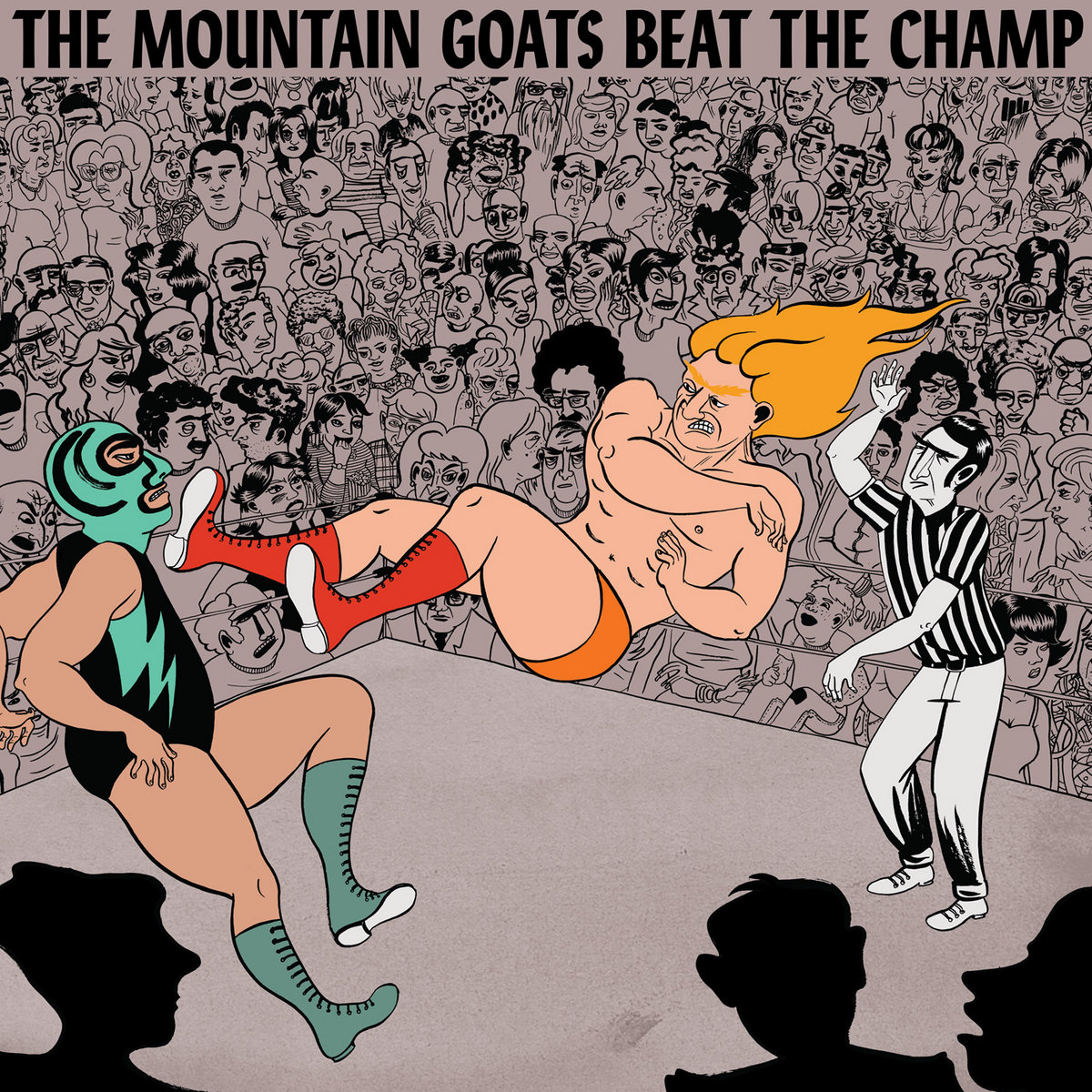
The Mountain Goats - Beat the Champ (2015) (Merge)
This topped my list of favorite albums of 2015, but that year was, to quote the musical Spring Awakening, totally fucked. I spent January through December in full on death anxiety mode as I was diagnosed with thyroid cancer, went through two radioactive iodine treatments each with a week spent in isolation, and a gnarly neck dissection where I spent almost a week in the hospital, three weeks recovering at home, and all I got was a lousy scar that looks like a drug lord tried to assassinate me and left me for dead but I survived, dammit. Beat the Champ and The Tallest Man on Earth’s Dark Bird is Home (more on that one later) were my companions through the periods of isolation, and Beat the Champ in particular was a wonderful distraction. In fact, it’s the reason I started watching pro wrestling again. I was a huge WWF fan in the late 90s when wrestling was resurgent, but I lost interest once the Monday Night Wars ended when WWF bought WCW. From the isolation chamber (read: my old bedroom in my parents basement) I checked out the WWE Network and the rest is history. My fandom was renewed. Thanks, John Darnielle.
Despite being a Mountain Goats diehard, this is weirdly the only one of their five 2010s albums to make the list. I’m not sure why that is. All Eternals Deck contended, and while I love all of their records, it might be that I have such a strong connection to the records from the 00s (Tallahassee and The Sunset Tree in particular, both of which are likely Top 10 of the century for me)that these are just like a fun bonus. Beat the Champ has a special place due to it being my partner in trauma, but I think Darnielle did a great job covering all of these different perspectives and fascinating elements of the wrestling world while also making an album that felt as personal as everything else he does. “Heel Turn 2” in particular is one of the absolute songs of the decade, and I have a real affinity for the jaunty “Foreign Object” where Darnielle gleefully sings, “I’m gonna stab you in the eye with a foreign object.” He canonizes legends like Chavo Guerrero Sr and Bull Ramos with these sweet tales of men living through countless battles to enjoy their old age, and pens one of the most deeply moving tracks in his catalog in “Unmasked,” about a masked wrestler booked to lose a mask vs. mask match and set to reveal his face to the world. Darnielle showed that there was grace in something as barbaric and impolite as professional wrestling, and that’s just what he does. He shines his light on the dark corners of the world and shows you that there is worth in these hidden places. That’s his great gift as a storyteller (his two novels--2014’s Wolf in White Van and 2017’s Universal Harvester--are as good as you think they would be) and even though his records don’t quite takeover my mind, body, and spirit like they used to, it still gives me tremendous comfort that he’s out there working his magic.
My all-time Top Ten records could easily be comprised
entirely of Mountain Goats albums. This is no joke. No songwriter speaks to my
soul quite like John Darnielle, and were he to forge some sort of tent-revival
spiritual following cult-like group, I would follow him into the dark night.
Putting nothing but Mountain Goats records in my Top Ten is easy, but deciding
the order is hard. I know the top three would be Tallahassee, The Sunset Tree, and All Hail West Texas, but the order is variable. Depends on the
mood. Tonight, it’s All Hail West Texas, and
it’s a no doubter. It’s simultaneously the last of JD’s boombox recordings and
also the first album that feels like an actual Album rather than a collection
of songs. It’s a great leap forward and the songwriting here is at another
level, which is astounding considering the level Darnielle was already writing
at.
The night I asked Jenny out on our first date, I played a
solo show at the Eighth Street Taproom in Lawrence. My band the Kite Tails were
scheduled to open but my bandmates couldn’t make the gig and, for some insane
reason, I decided to soldier on. I used it as an opportunity to cover some of
my favorite songs. I’d just spent a year going through a rough breakup, and
finally cut it off for good with my ex about a month before. I was still in an
ugly place, and I put a lot of sad breakup songs on that setlist. “Source
Decay” was right there in the middle, and despite practicing it fifty times in
the lead-up to the show, I forgot one of the verses late in the song.
Fortunately, someone in the crowd (I think it was this guy Cal, who.
Ironically, I ended up playing in another band with a year or so down the line)
knew the song and sang out the start of the verse and I finished with as much
aplomb as I could. I was nervous, but I got lost in that song. I still get lost
in that song every time I hear it. That night I was exorcising demons I’d been
living with for too long, and I feel like yelling those lyrics into a
microphone to 20 people in a basement in a college town finally got me to move
along. I drank my free beer, saw Jenny for the first time in months, and was
riding high enough on the emotional buoy of the show to break character and for
once in my life act with confidence.
That was almost 7 years ago, we’ve been together ever since,
and the Mountain Goats is one of our collective favorite bands. This is what we
listen to when we listen to music. This is what I listen to when I listen to
music, and I can’t talk about the Mountain Goats without getting evangelical
and emotional. I can only surmise that this is what people who love the Bible
feel like. They wanna share the good news, they want you to feel as amazing as
they feel when they interface with something deeply spiritual. For me,
listening to a Mountain Goats record is as close as I get to going to church. Especially
this one, which was finally reissued on vinyl last year, thank god.
The day after I was
diagnosed with thyroid cancer, John Darnielle announced the new
Mountain Goats record. I took it as a silver lining and immediately
ordered the deluxe edition, no questions asked. I remember something
about the color of the vinyl: one gold, the color of the championship
belt. One green, the color of the money made. Holding the records now
and having spent significant time with this beautiful record, it's
bittersweet. There's the glory mixed with the fact that pro wrestling
is a job done by hired professionals to sell it as reality.
What JD does so well
here is drive home the fact that while the outcomes may be scripted,
wrestling isn't fake. It's an industry populated by real people
making the most of their chosen profession. These are tales from a
time when heels might still get the shit beat out of them in the
parking lot. Years before the nod and the wink of the WWE and
wrestling's acceptance as a sort of people's theater.
I'm sure every
review of Beat the Champ has
featured the writer's own personal history with professional
wrestling, because I'm sure most of us have one. If you were a child,
there was no doubt a phase where you and your brother practice frog
spashes and suplexes on oversized stuffed animals (and each other) on
your parents bed when they were at work. We
made gimmicks modeled after our heroes: Stone Cold Steve Austin, the
Undertaker, Edge, and all three faces of Mick Foley who might as well
have represented the Holy Trinity in those days: Mankind, Dude Love,
and Cactus Jack. The father, the son, and the hardcore holy ghost.
The gods of the Attitude Era. We fiercely despised Ted Turner's WCW
and tuned in diligently every week to Monday Night Raw even though
our tuning in didn't influence the ratings of the Monday Night Wars.
This will all sound like white noise to those who suffered through
more highbrow childhoods reading books while being raised by parents
who took them to museums on weekends, but for me, there were a solid
three years where I lived and died by wrestling.
I'm
writing this from my childhood bedroom in the basement of my parents
house where I am staying in isolation due to the radioactive iodine
therapy that will allegedly wipe out the rest of the thyroid cells in
my body. There's a notebook buried down here that contains the
complete kayfabe history and lineage of the matches, feuds, and title
changes amongst the giant tub of WWF wrestling figures now sitting in
the laundry room. I printed images of belts off the internet and
superglued them to pieces of felt affixed with tiny pieces of velcro.
I hand painted the Jakks Pacific figures when their gimmicks changed.
I was SERIOUS about this shit. At 12 years old, I thoughtfully booked
my own federation in the Hrabe Basement Territory. I told stories,
crafted drama, and had insane matches. I made my dad take me to the
hardware store to buy chicken wire so I could build a Hell in a Cell
(complete with a trap door in the roof to recreate Mankind getting
choke slammed through the damn cage and onto the mat below). I cut
the hell out of myself building it and every time I played with it,
but every major “Pay Per View” in my lineage had to have a hell
in the cell match. My Luna action figure featured “real” hair,
which ended up getting singed off in a no holds barred no
disqualification match for the women's title. Other wrestlers were
blown up with firecrackers. Thrown off the deck. Nearly cooked alive
in a “Grill Match.” It was an insane fantasy playground, and it's
the main reason I fell in love with storytelling. It's why I love
books and movies and why I write. It facilitated a creative awakening
and though I no longer follow “sports entertainment,” as it is
called these days, I take offense anytime someone throws shade on
wrestling.
John
Darnielle understands this, and it's why these amazing character
studies are some of his best work in a body that has consisted of
solidly great work consistently since 1999. There
are a lot of ballads to pair up with a lot of heartbreak, and the
quietest moments—as on the showstopping “Unmasked” or the heart
wrenching closer “Hair Match”--leave you breathless. Then there
are the big, rollicking tributes to Chavo Guerrero Sr and Bull Ramos
that really capture the larger-than-life legacies of these regular
dudes who meant so much to so many people. Especially Darnielle, who
in “The Legend of Chavo Guerrero” notes in regard to his abusive
stepfather: “You let me down but Chavo never once did/ You called
him names to try to get beneath my skin/ Now your ashes are scattered
on the wind.” Fuckin' A.
Some
of the songs get violent, like the surprisingly joyous “Foreign
Object” which is about stabbing someone in the eye with the titular
object, and the brief, fist pumping “Choked Out” where the
subject absolutely glamorizes his hardcore style and issues
no-bullshit statements like “Everybody's got their limits/Nobody's
found mine.” And then like the genius he is, Darnielle twists that
line on the next track (and the album's finest song) “Heel Turn 2.”
“You found my breaking point, congratulations” proclaims the
beloved babyface actively turning the crowds cheers in to hissing
boos. It's full of quiet
desperation, sadness, and bittersweet satisfaction. Beat
the Champ is maybe the most
goddamn bittersweet album I've ever heard, based on the fact that
I've used that word like four times and that word runs through my
head every time I play the album.
I
only had a chance to listen the record on vinyl once before going
into isolation, but it was a wonderful experience. I was running
around the house, baby in arms, trying to get everything ready for my
extended leave from the household (read: getting my gaming consoles
packaged up for transport). Thyroid cancer is a highly beatable
cancer and Beat the Champ
has helped my attitude tremendously these last few months. Whenever I
started feeling uneasy about facing mortality, I just put on “The
Legend of Chavo Guerrero” or “The Ballad of Bull Ramos” or
“Werewolf Gimmick” and said fuck cancer. When the doctor brought
out the radioactive iodine in a lead container this afternoon, I
thought of it like a folding
chair or a foreign object. It
might not make it a fair fight, but when
you get ambushed all bets are off. I felt like Ric Flair talking
trash when I muttered, “Cancer, kiss my ass” before I threw back
the radioactive iodine pills, no doubt embarrassing myself in front
of the doctors but feeling goddamn great about having so much power
put in my hands after months of feeling powerless.
Beat the Champ isn't
Tallahassee or The
Sunset Tree and some of the
melodies feel cribbed from All Eternals Deck and
Transcendental Youth, but
it's probably the best songwriting you're going to find anywhere in
2015 and I love this album more than words can adequately express
because it was the album I needed.
I worked in a book store for the last five years and currently work at a library. Despite being surrounded by books, I am a terrible reader. I pick up a ton of books and take them home, but I somehow, until recently, have never been able to make time to read them. So when my favorite songwriter/musician/artist/overall human being John Darnielle released his debut novel Wolf in White Van, I dropped everything I was doing and read. It's an outstanding novel. I'm sure there is some bias in my opinion, as I regularly worship at the man's altar, but it was longlisted for the National Book Award so I can safely assume the novel's merits are legit.
Like many of Darnielle's songs, Wolf in White Van is about an outcast. Sean Phillips lives on the fringe, alone in his apartment with an occasional caregiver there to help because he will never fully recover from taking a bullet to the face. His head is like a horrific mask, drawing stares and revulsion from people who live in the world he is no longer a part of. As he can no longer be a part of society, he oversees and crafts a mailorder role playing game. In the game, players roam a destroyed wasteland en route to a fortress Trace Italian. Sean admits that it is impossible to enter the Trace. Salvation is a carrot on a stick, just as it is for Sean who bears the brutal personification of something horrible and will every day for the rest of his life.
As we learn about Sean's and the nature of his "accident" in reverse through his interactions in the outside world (buying candy from a liquor store, going to renew his business license) and flashbacks to the time before it happened, we are made privy to the tragedy of two Trace Italian players who took the game a step too far which shines a light on our culture's tendency to blame music, video games, and violent movies for the terrible things that people do. Needless to say, the novel is deeply sad. Of course, it's also heartbreakingly beautiful and full of so much soul and every line is like a gift to the reader. As I was reading, I was cobbling together a playlist of Mountain Goats tracks thematically/emotionally/spiritually similar to the text. Here are those songs.
"The Day the Aliens Came"
The intro says it all.
"Never Quite Free"
"Psalms 40:2"
In my head, this song played every time a tract from Trace Italian (and the tragedy of Lance and Carrie) was depicted. It helps that both the track and Trace Italian are based in the burning ruins of Kansas.
Take a band I already love and adore (The Mountain Goats)
and have them cover a band I’ve heard of, but never given a chance because the
recordings I heard sounded like garbage (Silver Jews’ The Arizona Record) and you basically have indie rock alchemy. “Pet
Politics” makes you stop whatever you’re doing and listen to David Berman’s
poetry. Even through the conduit of John Darnielle, the apocalyptic essence of
this song remains intact. I immediately got TheNatural Bridge and its follow-up, AmericanWater, but it was the latter that blew my mind. Just broke it wide open and
showed me the beautiful mind of America’s best contemporary songwriter. Ever
since I could appreciate music, I’ve been chasing the feeling that comes with
discovering a band that you’re going to carry with you the rest of your life.
This cover is good, but there’s a weight that Berman brings to the original
that just can’t be replaced by anyone.
The Mountain Goats – “New Chevrolet in Flames” "See America Right" Single, 4AD, 2002
Like clockwork, every new Mountain Goats record produces at
least 2-6 b-sides, most of which any other band would use as a lead single on
their latest album. John Darnielle is no mere mortal. Or wait, yes he is, that
is part of his appeal. He’s the everyman who apparently never stops writing.
Just a normal guy with a prolific streak that gives Bob Pollard a run for his
money. I’ll be covering a lot of Mountain Goats tracks hroughout this feature
promoting great B-Sides, but “New Chevrolet in Flames” from the Tallahassee sessions is not only my
favorite MTN GTS B-Side, but my favorite B-Side of all time. It helps that Tallahassee is my favorite album and
that the Mountain Goats are one of my favorite bands. It also has one of my
favorite lyrics: “Oh would that you would kiss me/ With the kisses of your
mouth/ Because your mouth is sweeter than wine and has a more complicated
history than the American South.” AND THIS TRACK WAS BURIED IN THE “SEE AMERICA
RIGHT” SINGLE! This lovely tale of getting drunk on Colorado Bulldogs
(effectively a White Russian with Coca-Cola added. After falling hard for this
song, I spent a period of three months asking bartenders if they knew how to
make one. Most didn’t, except one guy in Austin, who made me one of the most
delicious cocktails I’ve ever had) and setting a car on fire is a masterpiece.
A year and a half after the release of the last Mountain
Goats album—the magnificent All Eternals
Deck—John Darnielle and company are back with a brand new one that is, as
you’d expect, pretty great. Granted, I’m biased. I mean, I GUESS you could call
it biased, but when it comes to the Mountain Goats my rabid fanship is less of
a bias and more of a way of life. In terms of the Mountain Goats discography,
there are no bad albums. There are average ones, like Get Lonely and maybe some of the earlier ones which are too
disorganized to work as albums (and really, I don’t think they’re trying to
work as albums anyway), but most of them range from great (The Life of the World to Come) to really great (Heretic Pride) to heartbreakingly good (We Shall All Be Healed) to the greatest
thing I’ve ever heard in my life (All
Hail West Texas) and the other greatest thing I’ve ever heard in my life (Tallahassee). I’m probably not the only
person who’s thought about writing a screenplay/opera/ballet based on Tallahassee. That’s how we roll, I
suppose.
So there’s a new Mountain Goats album, Transcendental
Youth, and I have accepted it with open arms. Like every new MTN GTS
release before it, this one took me a while to warm up to before I loved it. I
don’t know why that is. As if my expectations are being let down a little bit
and then song-by-song the whole thing comes together and it’s like YES! And
it’s business as usual here. A song-by-song breaking down of my heart. Where
Darnielle has been fixated upon survivor stories of late (notably “Never Quite Free” from All Eternals Deck and
pretty much the entirety of The Sunset
Tree, although there were some people who didn’t make it through on that
one) and they are here in spades. Fuck-ups, rejects, failures. The kind of
people who, in Darnielle’s words, “people who madly, stupidly, blessedly won’t
stop surviving, no matter who gives up on them.” It’s a messy, life-affirming
affair. But then again, what Mountain Goats album isn’t?
The opening line is “Do every stupid thing that makes you feel alive,” for
fucks sake. I mean, seriously. And still, Darnielle & crew find ways to
diversify. The horn section courtesy of Matthew E. White adds something
fantastic and special and emotionally dissonant/triumphant to “Cry For Judas,”
“In Memory of Satan” and the title track. It’s a fun new side of the Mountain
Goats, but the most special collaboration is the one between Peter Hughes and
Jon Wurster who grow tighter as a unit each time around. One of my favorite
moments of any show ever was when some drunk ass girl talking way loud at the
very front of the stage at a Mountain Goats show at the Jackpot in Lawrence
years back almost got hit in the face by Peter Hughes bass and then immediately
after that (I think, in my head) was the part on “See America Right” where he
goes “Hey!” but in this version of the song he bellowed out “HEYYYYYYYY!” and
it was great. Though the Mountain Goats are John Darnielle’s thing—in the sense
that his lyrics are what draws people to this project moth/flame style—watching
them become a full-fledged band over the last five or so years has been so much
fun.
“The Diaz Brothers” is one of my favorite songs on the record, if only because
I spent like fifteen minutes trying to figure out the namesake of the titular
siblings (UFC fighters? I know how much JD loves fights, or is it just boxing?
Singers? Is it a metal thing?) until I realized pretty much every write-up out
there noted that the Diaz Brothers were basically the Rosencrantz &
Guildenstern of Scarface. And THEN I
fell in love with the song that much more. Darnielle always handles his
characters with a novelist’s grace. Even when they’re preexisting fictional and
non-fictional figures (Authors Sax Rohmer and HP Lovecraft, horror film villain
Michael Myers, and movie stars Charles Bronson and Liza Minelli have had their
own songs on the past handful of albums), drug addicts hold up in an apartment
waiting for “the guy with the angel dust” as in “Lakeside View ApartmentsSuite,” historical figures (like Billy the Kid on the psychotically great All Eternals Deck b-side “CatherineAtrim’s Kid”), and misfits. It’s Darnielle’s tributes to musicians that always
kill me. “Song for Dennis Brown” on The
Sunset Tree and “September 15 1983” from Heretic Pride (about the death of Prince Far I) are sad and
wonderful tributes to fallen reggae legends and here he pays tribute to tragic
doo-wop singer Frankie Lymon on the standout “Harlem Roulette.” Lymon’s death
by heroin overdose at the age of 25 is prime John Darnielle material. He
covered his own addictions on We Shall
All Be Healed and come to think of it, “Harlem Roulette,” “Song for DennisBrown,” and “September 15 1983” are all about singers who have died of
overdoes. If it haunts his songs, it must haunt him. I guess. Maybe that’s
where the joy comes from, because as depressing as any Mountain Goats song gets
there’s always a glimmer of hope lurking on the horizon.
Though Darnielle has openly stated that though he is a
recent father, this isn’t an album about being a father. It is however an album
about staying alive, and with a wife and kid in tow, you can tell that
Darnielle is just thankful to be around. “Every dream’s a good dream/ Even
awful dreams are good dreams/ If you’re doing it right,” he sings on “Harlem
Roulette.” There’s an appreciation of existence at work in his songs that
elevates them to a level of transcendence. And sure I’m biased, I’ve been a
huge fan of the Mountain Goats since the waning years of high school when I
heard Atom and His Package’s cover of “Going to Georgia” and followed that tip
down that long, tape-hiss laden rabbit hole and found a singer who made ever
little fiber of my soul vibrate with a sort of positivity I’d been lacking. And
I just don’t think Darnielle has ever let up. Every album is a treat and they’re
kind of beyond being assigned trivial ratings. And naturally, Transcendental Youth rules.
Annnd here's JD performing "Harlem Roulette" for Pitchfork. Absolute perfection. The way he looks like a possessed preacher, yeah, I'mma go ahead and be part of THIS religion.
Here's a heartbreakingly lovely solo-piano version of "In Memory of Satan."
And the spectacular opening track that I barely mentioned, "Amy aka Spent Gladiator 1"
Darnielle performed a number of songs from this record with the classical vocal quartet Anonymous 4 in New York months and months back, and here's what "Counterfeit Florida Plates" looked like. (Hint: If your math looked like "JD + Vocal Quartet = Lovely, kind of awkward but a fun twist on the Mountain Goats"then your math was correct).